
Buying a vintage watch can sometimes feel like learning a new language. Listings may mention terms such as automatic, hand-wind, quartz, mechanical, patina, calibre, crown, crystal or lug width.
If you are new to vintage watches, this simple guide explains some of the most common terms you are likely to come across.
Mechanical Watch
A mechanical watch is powered by a traditional system of gears and springs rather than a battery.
Mechanical watches can either be hand-wound or automatic.
Many vintage watches are mechanical, particularly watches produced before quartz movements became widespread during the 1970s and 1980s.
Hand-Wind or Manual-Wind
A hand-wound watch needs to be wound manually using the crown.
Turning the crown tightens the mainspring inside the watch, which gradually releases energy and keeps the movement running.
Depending on the watch, it may need winding approximately once every day.
With a vintage hand-wind watch, it is important not to force the crown once resistance is felt.
Automatic Watch
An automatic watch is also mechanical, but it winds itself while being worn.
A weighted rotor inside the movement moves as your wrist moves, helping to wind the mainspring.
If an automatic watch has not been worn for some time, it may stop and need to be wound or gently moved before wearing.
Quartz Watch
A quartz watch is powered by a battery and regulated by a quartz crystal.
Quartz watches became extremely popular during the 1970s and 1980s because they were generally more accurate and required less maintenance than traditional mechanical watches.
Many vintage quartz watches can simply have their battery replaced when they stop.
Movement
The movement is the mechanism inside the watch that makes it work.
You may sometimes hear it described as the watch’s “engine”.
Movements can be:
- Mechanical hand-wind
- Mechanical automatic
- Quartz
- Electronic
Calibre
A calibre is the particular model or design of a watch movement.
For example, two watches from the same manufacturer may look completely different on the outside but contain the same calibre movement.
The calibre number can often help identify a watch and may also be useful when searching for replacement parts.
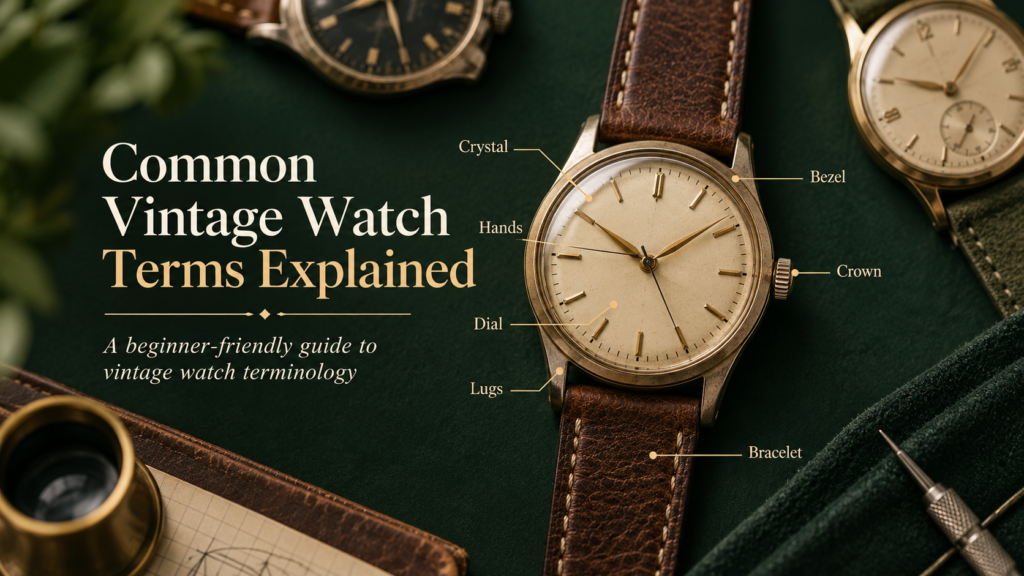
Crown
The crown is the small knob normally found on the side of the watch case.
It is usually used to:
- Set the time
- Adjust the date
- Wind a mechanical movement
Some sports and diving watches have a screw-down crown, which screws tightly into the case to improve water resistance.
Crystal
The crystal is the transparent cover protecting the watch dial.
Vintage watches may use several different types.
Acrylic crystal was very common on older watches. It scratches relatively easily but can often be polished.
Mineral glass is harder and more resistant to scratching.
Sapphire crystal is particularly scratch-resistant and is more commonly found on higher-end or modern watches.
Dial
The dial is the face of the watch.
It contains the hour markers, hands, branding and sometimes additional features such as a date window or chronograph sub-dials.
Original vintage dials can sometimes develop ageing, fading or marks over the years.
Patina
Patina describes the natural ageing that can develop on a vintage watch.
This might include:
- Colour changes on the dial
- Faded luminous material
- Slight ageing of hands
- Changes to metal finishes
Some collectors particularly like watches with attractive original patina because it gives the watch character and shows its age.
Hands
The hands indicate the time.
Most watches have:
- Hour hand
- Minute hand
- Second hand
Chronographs may contain several additional hands used for timing functions.
Lume
Lume is luminous material applied to watch hands or hour markers so they can be seen in low light.
Older watches sometimes used materials that have faded significantly over time.
Vintage lume can develop cream, yellow or brown colouring, which is often considered part of the watch’s natural patina.
Bezel
The bezel is the ring surrounding the watch crystal.
On some watches it is purely decorative.
Diving watches often have rotating bezels that were originally designed to help divers measure elapsed time.
Case
The watch case is the main body of the watch containing the movement and dial.
Common materials include:
- Stainless steel
- Gold
- Gold plate
- Gold tone
- Chrome plate
- Brass
Vintage watch cases often show normal age-related scratches and wear.
Case Back
The case back is the rear section of the watch case.
It may contain useful information such as:
- Model numbers
- Serial numbers
- Water resistance
- Case material
- Manufacturer information
Some watches have removable backs, while others use screw-down cases.
Lugs
The lugs are the sections of the watch case where the strap or bracelet attaches.
The distance between the lugs is known as the lug width.
Common vintage watch lug widths include 16mm, 18mm and 20mm.
Bracelet
A bracelet is a metal watch strap.
Vintage bracelets may be original to the watch or may have been replaced during the watch’s lifetime.
They can be made from stainless steel, gold-tone metal or plated materials.
Strap
A strap is usually made from leather, fabric, rubber or another flexible material.
It is very common for straps on vintage watches to have been replaced over the years.
Chronograph
A chronograph is a watch with a stopwatch-style timing function.
Chronograph watches usually have additional pushers on the side of the case and smaller sub-dials on the main dial.
A chronograph should not be confused with a chronometer, which has a completely different meaning.
Chronometer
A chronometer is a watch movement that has met specific accuracy standards.
The term relates to accuracy rather than stopwatch functions.
Sub-Dial
A sub-dial is a smaller dial positioned within the main watch dial.
Depending on the watch, it may display:
- Seconds
- Chronograph minutes
- Chronograph hours
- Date
- Day
- Other complications
Complication
In watchmaking, a complication is any function beyond simply displaying the hours, minutes and seconds.
Examples include:
- Date
- Day
- Moon phase
- Alarm
- Chronograph
- GMT or second time zone
Jewels
When a watch movement is described as having 17 jewels, 21 jewels or another number, this does not normally mean valuable decorative gemstones.
Small synthetic jewels are used inside mechanical movements to reduce friction between moving components.
Power Reserve
The power reserve is the amount of time a mechanical watch can continue running after it has been fully wound.
Vintage watches commonly have power reserves somewhere around 30–50 hours, although this varies considerably between movements.
Water Resistant
Water resistance describes how well a watch was originally designed to prevent water entering the case.
However, with vintage watches, seals and gaskets may have deteriorated over many years.
Unless a vintage watch has recently been professionally pressure tested, it is generally sensible to keep it away from water.
NOS – New Old Stock
NOS stands for New Old Stock.
This normally refers to an older watch or watch part that was never sold or used when originally manufactured.
True NOS vintage watches can sometimes remain in remarkably good condition.
Original
When sellers describe something as original, they generally mean that the part has remained with the watch since manufacture.
Collectors may particularly value original:
- Dials
- Hands
- Crowns
- Movements
- Cases
- Bracelets
However, vintage watches often have replacement straps, crystals, crowns or other parts due to normal maintenance during their lifetime.
Serviced
A serviced mechanical watch has usually had its movement inspected, cleaned, lubricated and adjusted by a watchmaker.
The exact meaning of “serviced” can vary, so it is always worth checking what work has actually been carried out.
Running
When a vintage watch is described as “running”, it normally means that the movement is currently operating.
This does not necessarily mean it has recently been professionally serviced or tested for long-term accuracy.
Timekeeping
Mechanical vintage watches should not necessarily be expected to keep time as accurately as a modern quartz or digital watch.
Small gains or losses over a 24-hour period can be normal depending on the age, movement and servicing history of the watch.
Why Understanding Vintage Watch Terms Helps
Learning a few basic watch terms makes it much easier to understand listings and compare different watches.
It can also help you decide whether you prefer the traditional character of a mechanical watch, the convenience of quartz, or a particular style such as a diver, chronograph or dress watch.
Every vintage watch has its own history, and signs of age are often part of what makes older watches so interesting.
At VintageWatches.online, we specialise in pre-owned and vintage watches from a wide variety of manufacturers, styles and periods.
Browse our latest collection and discover a vintage watch with a story of its own.
Browse our Men’s Watches collection.
our* *Ladies’ Vintage Watches* collection.*