
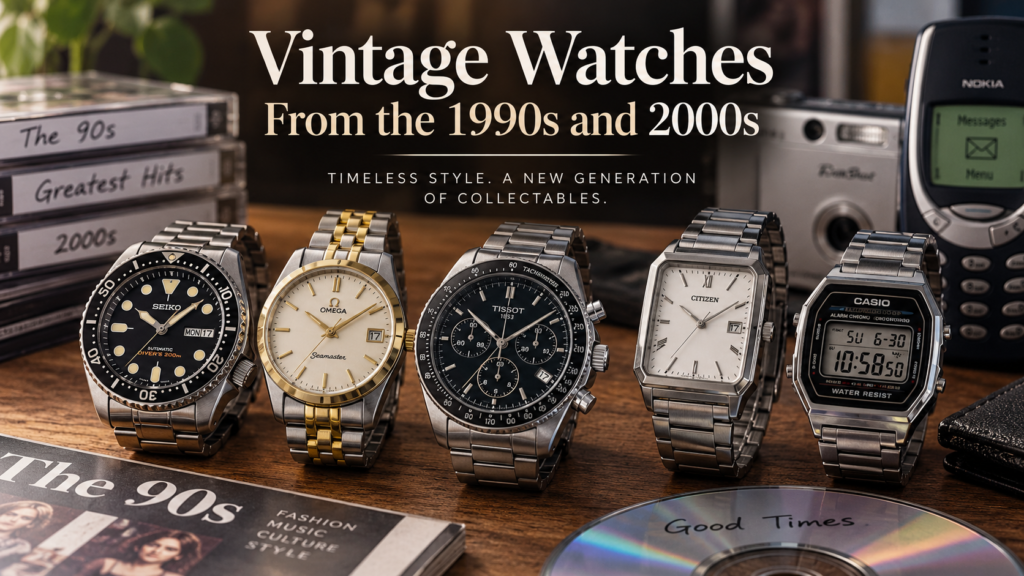
When people hear the words vintage watch, they often picture a mechanical timepiece from the 1950s, 60s or 70s. But another generation of watches is now starting to attract collectors: those made during the 1990s and early 2000s.
For many buyers, these watches represent the designs they remember growing up with. For others, they offer an affordable way to own an interesting, well-made timepiece without paying the increasingly high prices associated with much older vintage watches.
At VintageWatches.online, we believe this era deserves much more attention.
Are 1990s Watches Really Vintage?
There is no universally agreed age at which a watch officially becomes “vintage”.
Traditionally, collectors often used the term for watches that were around 20 to 30 years old or more. That means many watches produced during the 1990s now comfortably fall into the vintage category, while early-2000s watches are increasingly being described as neo-vintage.
More importantly, age isn’t the only thing that makes a watch interesting.
The design, movement, history, rarity and the era it represents can all make a watch collectable.
Why the 1990s Were Such an Interesting Period
The 1990s produced a huge variety of watches.
Quartz technology was firmly established, allowing manufacturers to produce accurate and reliable watches in an enormous range of styles.
At the same time, traditional mechanical watches never completely disappeared.
Brands including Seiko, Citizen, Tissot, Rotary, Pulsar and many others produced everything from simple dress watches to chronographs, divers and sports watches.
It was also an era when watch design became increasingly adventurous.
Two-tone bracelets, gold-tone cases, colourful dials, compact men’s watches and distinctive chronographs were everywhere.
Many of these designs are now beginning to look appealing again.
Smaller Watches Are Returning
One of the biggest differences between watches from the 1990s and many modern watches is their size.
Men’s watches measuring somewhere around 32mm to 38mm were perfectly normal.
During the 2000s and 2010s, watches became considerably larger, with 42mm, 44mm and even larger cases becoming commonplace.
Today, tastes are changing again.
Smaller and more traditional case sizes are returning to fashion, which means many watches from the 1990s suddenly feel surprisingly modern on the wrist.
A watch that might once have seemed small can now look elegant, understated and extremely wearable.
Early-2000s Watches Are Becoming Collectable
Watches from the early 2000s are also beginning to enter an interesting period.
For years, many were simply regarded as used watches rather than collectables.
That is starting to change.
As original examples become harder to find, buyers are beginning to appreciate distinctive early-2000s designs, particularly models that still retain their original dials, bracelets and cases.
This is often how collecting trends begin.
Every vintage watch was once simply an ordinary watch.
Quartz Watches Shouldn’t Be Ignored
Vintage collecting is sometimes dominated by mechanical watches, but dismissing quartz watches would mean ignoring an enormous part of watchmaking history.
A good-quality quartz watch can offer several advantages.
It is generally accurate, easy to wear and often far less expensive than an equivalent mechanical vintage watch.
Quartz watches from brands such as Seiko, Citizen, Pulsar, Tissot and Rotary can also offer excellent build quality.
And because quartz watches were produced in so many different designs during the 1990s and 2000s, there are still unusual pieces waiting to be rediscovered.
Nostalgia Plays a Big Part
Collecting isn’t always about investment.
Sometimes we simply want something that reminds us of another time.
A watch can instantly bring back memories of a particular decade, fashion style or period of our lives.
For someone who grew up during the 1990s, finding the same style of watch their father wore, the watch they wanted as a teenager or even a model they once owned can make it far more meaningful than a brand-new watch.
That emotional connection is one of the things that makes vintage collecting so enjoyable.
Are 1990s and 2000s Watches a Good Investment?
Nobody can reliably predict which watches will rise significantly in value.
However, there is an advantage to buying watches from this period: many remain relatively affordable.
Rather than concentrating entirely on investment potential, look for watches you genuinely like.
Original condition, an attractive dial, an unusual design, a respected manufacturer and a good-quality movement can all add to a watch’s appeal.
Certain discontinued models may become increasingly difficult to find as the years pass.
But the best reason to buy any vintage watch is still because you want to wear and enjoy it.
What Should You Look For?
When buying a watch from the 1990s or 2000s, condition is important.
Look carefully at the dial, case, bracelet and crystal.
Some scratches and signs of wear are entirely normal on a watch that may have been worn for 20 or 30 years.
In fact, a few signs of age can form part of its character.
Check whether the watch is running correctly and, with mechanical watches, remember that the service history may not always be known.
With quartz models, a fresh battery and a period of testing can provide useful reassurance that the watch is operating correctly.
You should also assume that an older watch is not waterproof unless it has recently been professionally pressure tested, regardless of what may originally have been printed on the dial or case.
The Next Vintage Watch Boom?
Collecting tends to move through generations.
Watches from the 1960s and 70s have already experienced huge increases in interest.
The 1980s has become increasingly fashionable.
The 1990s is now following.
And the early 2000s won’t be far behind.
There are still thousands of fascinating watches from this era available at sensible prices, making now an excellent time to explore them.
You don’t necessarily need a famous luxury name on the dial either.
Sometimes the most interesting vintage watches are the unusual pieces that everyone else has overlooked.
Final Thoughts
Vintage watches from the 1990s and early 2000s offer something slightly different.
They combine nostalgia, distinctive styling, everyday usability and often very reasonable prices.
Whether you prefer a classic Seiko, an unusual Citizen, an elegant Rotary, a Swiss-made Tissot or simply a watch whose design catches your eye, there is an enormous variety to discover.
Today’s forgotten watch could easily become tomorrow’s collectable.
And perhaps that is one of the greatest pleasures of vintage watches — you never quite know what you’re going to find next.
Explore our collection of pre-owned vintage watches at VintageWatches.online and discover a timepiece from an era that’s rapidly becoming collectable.