
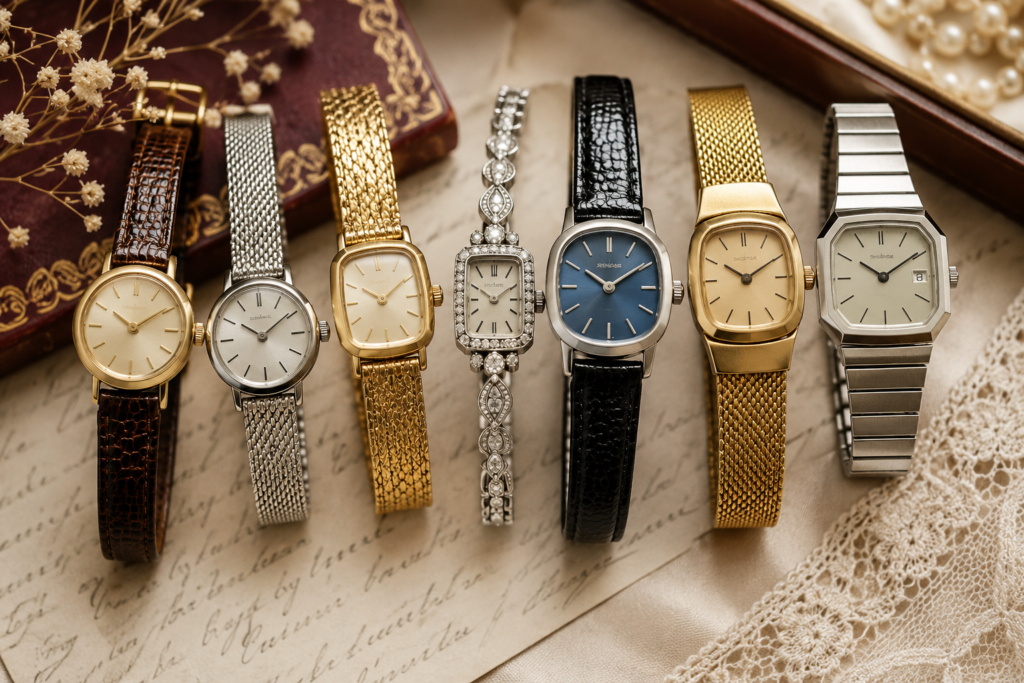
Vintage ladies’ watches offer something that many modern watches simply cannot replicate: character, elegance and individuality.
From tiny hand-wound watches of the 1950s and 1960s to elegant gold-tone pieces, classic Swiss designs and colourful quartz watches from the 1980s and 1990s, there is an enormous variety to discover.
They can also represent excellent value. While much of the vintage watch market focuses on larger men’s models, beautiful ladies’ watches from respected makers can still often be found at surprisingly accessible prices.
If you are thinking about buying your first vintage ladies’ watch, here are the most important things to consider.
1. Don’t Be Put Off by a Small Watch
One of the biggest differences between modern and vintage ladies’ watches is size.
Vintage watches made for women were frequently much smaller than today’s watches. Cases around 20–30mm are perfectly normal, and some elegant cocktail watches are smaller still.
That isn’t a disadvantage.
A smaller vintage watch can look beautifully proportioned on the wrist and often has an elegance that is difficult to reproduce with a larger modern design.
Don’t judge a watch solely by its diameter. Case shape, dial size, bezel width and bracelet design can dramatically affect how large a watch appears when worn.
2. Quartz or Mechanical?
You will encounter both mechanical and quartz vintage ladies’ watches.
Mechanical Watches
A traditional mechanical watch operates without a battery. A manual-wind watch is wound using the crown, while an automatic movement uses the movement of the wearer to help keep it wound.
For many collectors, this is part of the appeal. There is something special about wearing a tiny mechanical machine that may have been keeping time for 40, 50 or even 70 years.
Mechanical watches do, however, require periodic servicing.
Quartz Watches
Quartz watches became enormously popular from the 1970s onwards and are an excellent option for somebody who wants an easy-to-wear vintage watch.
They are battery powered, generally accurate and require less day-to-day attention.
Don’t dismiss a watch simply because it is quartz. Vintage quartz watches from makers such as Seiko, Citizen, Tissot, Rotary and Pulsar can offer attractive designs and excellent value.
3. Look Carefully at the Condition
Condition is particularly important when buying vintage.
Some signs of age are entirely normal. Light scratches, small marks and gentle dial ageing are part of the history of an older watch.
In fact, many collectors would rather own an honest vintage watch showing appropriate age than one that has been heavily polished or restored.
Pay particular attention to:
- The dial and hands
- The condition of the case
- The crown and winding action
- The crystal
- The bracelet and clasp
- Signs of corrosion or moisture damage
A good seller should provide clear photographs and point out significant imperfections rather than attempting to hide them.
4. Originality Matters — But Be Realistic
Originality can influence the desirability and value of a vintage watch.
An original dial, hands, crown and bracelet can make a watch particularly attractive to collectors. However, components are sometimes legitimately replaced during decades of maintenance.
A replacement crystal or strap, for example, would not normally concern us greatly on an otherwise attractive everyday vintage watch.
What matters is honesty.
If something is known to have been replaced, it should be described accurately rather than presented as original.
5. Check the Bracelet or Wrist Size
This is especially important with vintage ladies’ watches.
A leather strap is easily replaced, but an original metal bracelet may be much harder to enlarge if links have been removed over the years.
Before buying, check the maximum wrist size stated by the seller.
If you already own a comfortable watch, measure that bracelet and use it as a comparison.
A beautiful watch isn’t much use if the bracelet is an inch too small and additional links are impossible to find.
6. Gold Tone, Stainless Steel or Solid Gold?
Vintage ladies’ watches were produced in a huge range of materials and finishes.
Stainless steel is practical and versatile.
Gold-tone and gold-plated watches provide the classic vintage appearance without the price of solid gold.
There are also beautiful 9ct and 18ct gold ladies’ watches, particularly among older Swiss and British pieces.
When buying gold-tone or plated watches, inspect photographs carefully for wear to the finish, especially around the edges, bracelet and case back.
7. Brand Isn’t Everything
Famous names naturally attract attention, but concentrating solely on the name printed on the dial can mean overlooking some wonderful watches.
Alongside internationally recognised manufacturers, many smaller Swiss, British and Japanese brands produced excellent watches.
A beautifully preserved watch from a lesser-known manufacturer can sometimes be a much better purchase than a poor example carrying a prestigious name.
Buy the watch, not simply the badge.
8. Ask About Its Mechanical Condition
A vintage watch can be running without necessarily having been recently serviced.
If the service history isn’t known, assume that servicing may eventually be required and factor that into your decision.
For quartz watches, check whether the watch has been tested with a fresh battery.
For mechanical watches, ask whether it winds correctly, sets correctly and has been tested over a reasonable period.
No responsible seller should promise that a decades-old mechanical watch will perform with the precision of a brand-new quartz watch.
9. Be Very Careful Around Water
One rule is particularly important:
Never assume a vintage watch is water-resistant.
Even watches originally sold as water-resistant can have ageing seals, crystals and crowns. Unless a vintage watch has been professionally pressure tested recently, it is safest to keep it away from water.
That means removing it before swimming, bathing or showering.
10. Look Beyond Perfect
One of the pleasures of buying vintage is that two watches of the same model can have developed completely different personalities.
A softly aged dial, tiny marks on a case or gentle wear from decades of use can tell part of the watch’s story.
Perfect isn’t always better.
The key distinction is between honest age-related wear and actual damage.
Why Are Vintage Ladies’ Watches Worth Considering?
Perhaps the strongest reason is simply choice.
Modern watch shops can be dominated by similar designs and larger cases. Vintage watches open up decades of different fashions, colours, shapes and movements.
You might discover a delicate 1960s hand-wound Swiss watch, an elegant 1970s cocktail watch or a wonderfully distinctive 1990s quartz model.
And because every vintage watch has already lived a life before reaching its next owner, buying one feels very different from simply choosing another mass-produced accessory.
Final Thoughts
A good vintage ladies’ watch doesn’t need to be expensive or carry a famous name.
Look for a watch you genuinely enjoy wearing, check its condition carefully, make sure it fits your wrist and buy from a seller who describes it honestly.
Above all, remember that vintage watches are old mechanical or electronic objects. Small signs of age should be expected and are often part of their charm.
Choose carefully and a vintage ladies’ watch can become far more than a way of telling the time.
It can be a little piece of history you get to wear every day.
Looking for your first vintage watch? Browse our Men’s Watches collection.
Explore our Ladies’ Vintage Watches collection.