
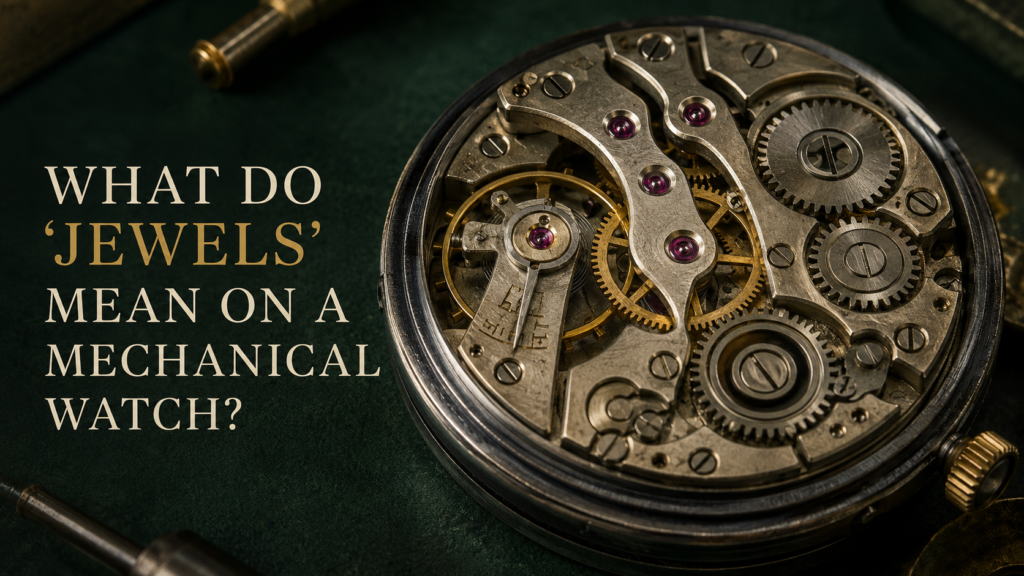
If you look closely at the dial or movement of a mechanical watch, you may see words such as “17 Jewels,” “21 Jewels” or “25 Jewels.” This does not mean the watch contains valuable diamonds or gemstones. The jewels are tiny, extremely hard bearings fitted inside the movement to help it operate smoothly and reliably.
Why Are Jewels Used in Watches?
A mechanical watch contains numerous moving components. Several of these parts rotate or oscillate thousands of times every hour.
If metal components continually rubbed directly against each other, friction would gradually cause wear and could reduce the accuracy and lifespan of the watch. Watchmakers therefore use small jewels at important contact points within the movement.
These jewels provide a hard, smooth and durable surface. They reduce friction, hold small rotating pivots in the correct position and help protect the delicate movement from premature wear.
Are Watch Jewels Valuable?
Most jewels used in modern and vintage watch movements are synthetic ruby or sapphire. They have the same useful hardness and smoothness as natural stones but are manufactured specifically for watchmaking.
They are not normally valuable when removed from the movement. Their importance comes from the job they perform rather than their monetary value.
Earlier watches sometimes used natural gemstones, but synthetic jewels became widely used because they could be produced consistently in the precise shapes and sizes required.
Where Are the Jewels Located?
Jewels are normally fitted at points where friction and wear are most likely to occur. These can include:
- The balance wheel pivots
- The escape wheel
- The pallet fork
- The gear-train wheels
- The automatic winding mechanism
Some jewels act as small bearings with a hole through the centre. Others serve as cap jewels, supporting the ends of delicate pivots. The pallet fork also uses specially shaped stones that interact with the escape wheel.
These components help control the release of energy through the movement, allowing the hands to advance at a measured rate.
What Does “17 Jewels” Mean?
A traditional hand-wound mechanical movement often uses 17 jewels. This is commonly considered a fully jewelled arrangement for a straightforward movement displaying hours, minutes and seconds.
A typical 17-jewel movement uses jewels throughout the gear train, escapement and balance assembly. However, the exact arrangement can vary between different manufacturers and calibres.
Automatic watches often contain additional jewels because their self-winding mechanisms require more moving parts. Watches with date displays, chronographs or other complications may also need extra jewels.
For this reason, you may encounter movements marked:
- 7 jewels
- 15 jewels
- 17 jewels
- 21 jewels
- 25 jewels
- 30 jewels or more
Does a Higher Jewel Count Mean a Better Watch?
Not necessarily.
A watch with 25 jewels is not automatically better, more accurate or more valuable than a watch with 17 jewels. The appropriate number depends on the movement’s design and functions.
Additional jewels can be useful when they support genuine moving components. However, some manufacturers historically promoted unusually high jewel counts as a marketing feature, even when some of the extra jewels provided little practical benefit.
The quality of a mechanical watch also depends on its movement design, materials, manufacturing standards, adjustment, condition and servicing history. A well-maintained 17-jewel watch can be far more reliable than a neglected movement with a higher jewel count.
Are Watches With Fewer Jewels Poor Quality?
Not always. Some older, simpler or more affordable watches were made with fewer jewels and can still be attractive and collectable.
However, movements with very few jewels may have metal-on-metal contact at some pivot points. Over many years, this can produce greater wear—particularly if the watch has been used heavily or has not been serviced correctly.
Condition is therefore particularly important when buying an older mechanical watch. A qualified watch repairer can check for worn pivots, damaged bearings and dried or contaminated lubricant.
Do Jewels Remove the Need for Lubrication?
No. Jewels reduce friction, but a mechanical movement still needs the correct watch oils applied in extremely small amounts.
Over time, these lubricants can dry out, spread or become contaminated. Continuing to run a dry or dirty movement can cause unnecessary wear, even when it contains a full set of jewels.
This is why periodic professional servicing is important for a mechanical watch, especially one that is worn regularly.
Why Jewel Counts Matter to Collectors
The jewel count can provide useful information about a movement’s construction, but it should never be considered on its own.
Collectors usually also examine:
- The manufacturer and movement calibre
- Whether the movement is hand-wound or automatic
- Its overall condition
- Its originality
- Its service history
- Its timekeeping performance
- The availability of replacement parts
The jewel count is one part of the watch’s story—not a simple measure of quality or value.
Final Thoughts
Jewels are among the smallest components inside a mechanical watch, but they perform an essential role. By reducing friction and supporting delicate moving parts, they help the movement run smoothly and resist wear.
When a watch says “17 Jewels” or “25 Jewels,” it describes part of the movement’s construction. It does not mean the watch contains valuable gemstones, and a larger number does not automatically make it superior.
Ultimately, thoughtful engineering, good condition and proper maintenance matter far more than the number printed on the dial.
Looking for your first vintage watch? Browse our Men’s Watches collection.
Explore our Ladies’ Vintage Watches collection.